

In this send:
Peptides, BTL, Restylane, PDGF, medical tourism, liposculpture, COVID vaccine, topical Ghk-Cu, vaginal health, Dr. Levine, TM, cellulite, TikTok, GLPs, anti-inflammatory diets…
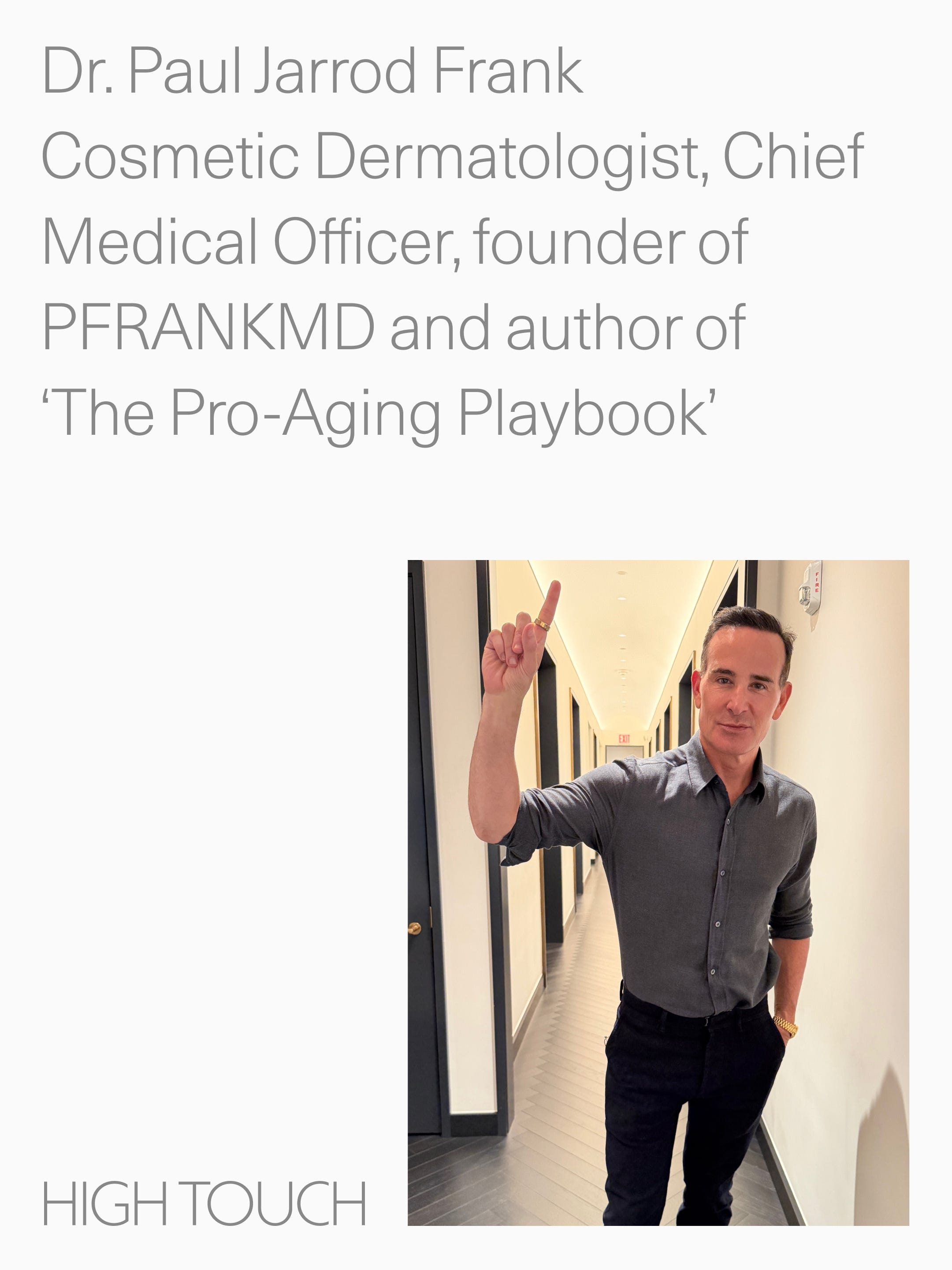
Welcome back to High Touch. A couple weeks ago I popped into the West Village office of Dr. Paul Jarrod Frank, cosmetic dermatologist and chief medical officer and founder of PFRANKMD and author of “The Pro-Aging Playbook”. He’d topped my list as someone to speak with for launch week after his name was passed to me multiple times during background interviews with professionals when researching this new vertical.
For people who feel the way about a list of aesthetic services the way others do when reading the martini menu at The Grill or a price list at a Prada sample sale—me, to all—Dr. Frank’s website is a dopaminergic blast of anticipation. Tools I know first hand like Morpheus8, Vbeam, and Clear & Brilliant jump out amid tons I haven’t tried or even heard of: Ellacor, AviClear, Aerolase NeoElite Laser (would make beautiful names for a girl), etc. There’s a whole section just for longevity interventions…Niagen IV Therapy, Pelvic Strengthening, even ExoMind, which, to paint a picture, uses magnetic energy to treat depression and is FDA-cleared!
Dr. Frank is a prime example of keeping a stacked deck while playing a conservative hand. More from him on the cosmetic-cultural paradigm shift underway and, more practically, what works and what’s probably a scam, below. But first, some things we saw, heard, chewed on this week.
A touch of High Touch
Withings, maker of smart scales, wellness tracking watches, heart rate monitors, and other consumer health tech, released its first-ever report on menopause based on data from 2.5 million women using its devices. It’s certainly one of if not the biggest data pools studied (across 11 countries) and includes some alarming metrics…including the fact that visceral fat increases by 58% during this time even while overall weight remains stable and that women miss perimenopause cues by a full decade. This is big.
The Sephora of K-beauty, Olive Young, opens its first US store (and domestic ecomm) today in Pasadena, with five more locations planned in California over the next year. It sells topicals from brands known to the aesthetics world including Rejuran and Medicube, plus ingestible collagen, kombucha tea bags, probiotic capsules…that sort of thing. The company did over $4 billion USD in sales last year in Korea.
I’m about a month into a two-month pulse of Timeline’s urolithin A-containing Mitopure supplement; it’s supposed to help support muscle strength and clear out old mitochondria. It’s funny to see this proprietary tech from my gym bro stack show up in a Lancôme skincare line called “Absolute Longevity MD”—topical use is mechanistically plausible, and the brand-sponsored RCTs did show improvements in signs of sun damage. Still, the whole partnership is dripping with Demi Moore and TDWP2 to the point where you have to wonder what it’s trying to distract you from.
Laura Reilly: How long has longevity been a part of your practice?
Dr. Paul Jarrod Frank: Since I started. I have felt that, in a sad way, wellness and beauty used to sit on the opposite sides of the cafeteria when they were always the same thing. Dermatology is no better profession to understand this concept. Generally, beautiful skin is a reflection of the health of the skin. And you can’t see that with our liver, and our brain, and all these things, because [skin] is the largest organ, but it’s all visual.
I’ve always had this idea of “pro-aging,” not “anti-aging.” I started that about 10 years ago, and then in 2019 I wrote my book “The Pro-Aging Playbook.” It was really all about how beauty starts from within, and the things that I’m trained to do are icing on the cake. There’s only so much I can do. I’m having conversations with patients about getting surgery all the time. I don’t dissuade people—if they don’t want it, they don’t want it.
LR: Are you having a conversation with your patients about their lifestyle?
PJF: Eating habits, drinking habits, what their goals are. I talk to them about all of these things. The difficulty right now, which I like the most, is reeducating people, because there’s so much nonsense out there. The regenerative medicine stuff, the peptide gray market, the supplement market, these are all super exciting things in the future. But people don’t want to wait for data. They want to jump on bandwagons. But it’s teaching the ethos of pro-aging and living inside-out.
I went to school to become a dermatologist, and it was as simple as just being involved in skincare—being involved in the health of the skin, the beauty of the skin aesthetically. Now I look at it as: I want to empower people to feel comfortable about aging. Unfortunately, everyone comes in with very specific complaints and feeling that they’re going through it alone. I tell people, “You are special, but you are not uncommon.”
The first thing is to help empower people to feel good about the process. What they don’t realize is that we are all spoiled. A hundred years ago or 150 years ago, life expectancy was half of what it is right now. We’re actually doing quite well, and it’s a blessing to get old and see the wrinkles on our face. We weren’t meant to watch ourselves age. So it’s natural as visual creatures to want the inside and the outside to match. Now we have the technology, and we’re learning a lot about lifestyle things to hopefully help us not only have longevity, but also to have a better health span. There are a lot of technologies and things out now that are combined with that, like peptides, like the BTL products. Using technology that works on the inside, not just on the outside.
LR: You’ve had your practice for 25 years—what did longevity look like then? What kinds of interventions were you recommending?
PJF: I was trying to get patients to let me treat their rashes and do occasional Botox. Lasers were very rudimentary. I took out government loans, and I thought I had the most cutting edge practice, because I had a hair-removal laser, a vascular laser, a pigmented lesion laser. That was it. I always told people, because they’d come in with complaints—“this wrinkle bothers me, this bothers me”—I told them, the healthier we can get your skin, the better you’re going to feel about the way you look.
The first cutting-edge technology that is probably the most impactful thing of my career was Fraxel, which was a non-ablative, no-open-skin way to target sun damage and rejuvenate the skin. That was the ultimate pro-aging device. I do have patients that don’t care about their sun spots, broken capillaries, and things like that, but they do when I tell them it’s those things that are the precursors to wrinkles and loss of elasticity and need for a facelift. I can get your skin healthier, there’s a trickle effect of so many other things.