

In this send:
Barrier function, acid mantle, microbiome, fibroblast function, mitochondrial function, extracellular matrix, senescence, transepidermal water loss, glycation, happiness, purpose, community, pH balance, caratenoids, estradiol, copper peptides…
Hi! Welcome back to High Touch. When I launched this newsletter, multiple people reached out to me unprompted to tell me I had to speak to Kristina Holey. Cold emails, pulling me aside at events. It happened a lot. Kristina, a cosmetic chemist and skincare consultant, was framed to me as the thing that finally made a difference in people’s—sometimes lifelong—battles with their problematic skin.
Kristina formulates products for Marie Veronique, a philosophically in-step brand, but her consultations are a class of their own in a skin-support strategy that might also include a facialist, dermatologist, injector, acupuncturist, surgeon; she is the foremost topicals authority. We discuss the eight components of skin that can be addressed by product (and in which order), how to spot a real skincare brand as opposed to a marketing vehicle, diet-as-skincare myths, ingredient lists being enormously misleading, AI (inevitably), her network of trusted aestheticians in New York and California…lots more.
The full video interview is above, and our conversation’s highlights are transcribed below. Ignore the pimple under my eye that emerged right on time for this call, naturally! But first, what else is up in our aesthetic, longevity world:
A touch of High Touch
An elective breast imagining facility, BeSound, opened its first ultrasound imaging clinic in New York near Union Square last week. It’s clear to state that it’s not a replacement for a mammogram or physician care, but what it is is an option for women under 40 who aren’t eligible for the standard-of-care screen yet; radiation-, compression-, and contrast dye-free; and something that can be done in 20 minutes, with results as fast as same-day. It costs $349.
The brand Allies of Skin released a boxed set of 30 ampoules designed to be used over 4 months as an anti-aging protocol—it costs $750. It’s a combination of three “complexes” of exosomes, peptides, and retinol, so…all the buzzword ingredients. I would personally never drop that on a topical, but if you try it let me know—we’ll put it in In Vivo!
I got served an IG ad for a company called Memory Air that claims it can improve your cognition / memory with a little box you keep my your bed that wafts out scents while you sleep. It’s based on a UC Irvine study that ran this experiment in a lab and found 226% improvement in memory in “normal” people and a 300% improvement in dementia patients. An exogenous option for your nootropic stack, if your nightstand has any room left.
My nightstand is partially occupied by a 10k lux lamp for melatonin / cortisol regulation and SAD, but Brighter makes one that goes up to 60k lumens (slightly different metric, but basically 60k is blindingly, stadium-bright—don’t try and use them in the same way). They market their floor lamp as “So effective an AI company bough 150,” so, in case your productivity needs also demand the complete eradication of night…
An ex-Ghia exec launched a water testing mail-in kit company called Rose. It tests for 100+ contaminants including xylene, benzene, and lead. They sent me a kit (that I haven’t tried yet—will keep you posted when I do), with instructions to stick the included ice pack in the freezer right away, so that after you capture your sample, you can pack it up together and ship it off to the lab straight away. They plan on expanding into more home tests for microplastics, airquality, mold, etc. Basically, they want to be the Function Health of your home.
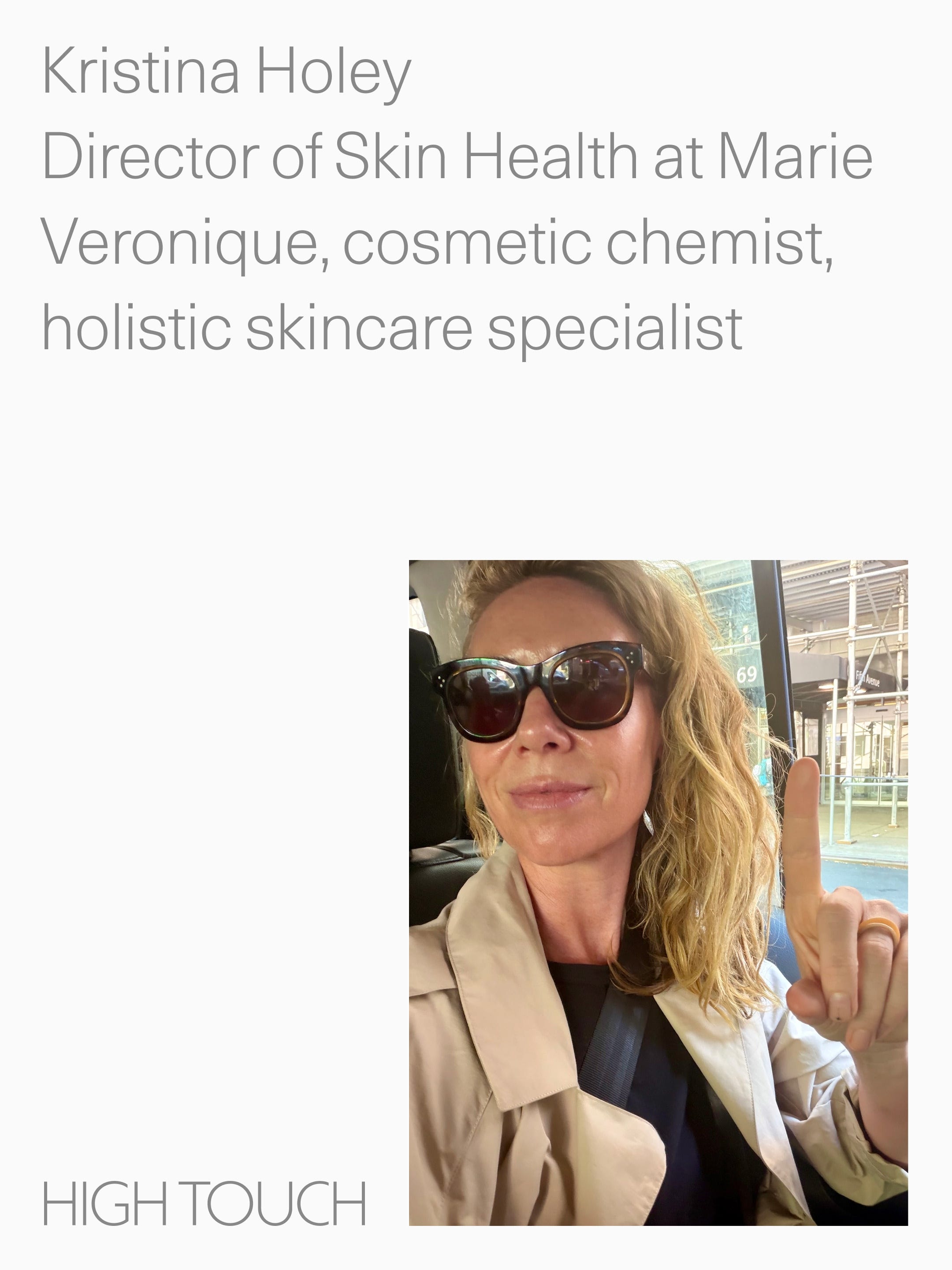
Laura Reilly: How do you describe what you do, and how did you arrive at this place?
Kristina Holey: I think of myself as a product designer. I work with a company called Marie Veronique and have for about 10 years—with the R&D department and designing skincare products. I'm also a skin health specialist and have been doing that for a little bit longer than working in the product world. I started off by building a business where I worked with women specifically with symptomatic skin. So, anything that related to inflammatory skin conditions was what was naturally coming to me in terms of clients that were wanting my support. I still work one day a week with clients. I do only virtual consultations, I don't see anyone in person.
My way into the industry was indirect. I wanted to be a perfumer. I went to school for engineering first, and then I did my Master’s in perfume chemistry and cosmetic chemistry in France. It was really my dream to be a niche perfumer. What I loved about the beauty industry was this ability of transformation, and fragrance was interesting to me because it was this medium in which you could communicate invisibly—you could transform your being in this secret way. I did start a little consulting company in Paris where I would go into people’s apartments and get to know their lifestyle, about their health, what they like, what made them feel beautiful, and then I would make them little trios of fragrances.
I got sideswept into skin in Paris by this woman who has a skin care center. Her name is Joëlle Ciocco, she still has it and it's very elite and crazy. Her treatments are like €3,000. She's a biochemist and we went to the same program for cosmetic chemistry. She brought me in as her intern; I had the intention of working in her lab and helping her with the formulation of her products, but then she convinced me to work in her center. I sat for an entire year in a chair next to her and watched her work with people, with the skin. I was really taken by that and her because it made me realize how complex the skin is—all the psychology and the emotional side that is involved with helping people feel beautiful. What an honor it is to have that role in working with primarily women.
After working with her I moved to New York and I started a practice there. I had never gone to school to become an aesthetician, but I started an aesthetician practice, which was a bit complicated because I didn't have a license or anything. I convinced the New York board of cosmetology that I had eight years of chemistry and biology and that I could sufficiently practice on people's skin and they gave me a license. It just kept evolving from that. I moved to California and I met Marie. We co-formulated a line specifically for my clients. This was about 10 years ago. And then our relationship really grew and kept getting stronger.


